Worn out, torn, or broken orthotics can cause more problems to your feet. Orthotics are a medical device used to assist in mobility while correcting the function of the foot. They allow a patient to perform their daily movement with ease. If you are using orthotics and you experience inconvenience, discomfort, and inflammation, it is time to get new inserts. Available over-the-counter orthotics are for different foot problems. Flat Feet Insole Support and Custom Orthotics Houston are designed by a foot doctor to correct foot deformities and provide relief.
Ignoring the health of your foot, ankle, and toes will come at a cost. Regular stretching and exercising of the feet and ankles increase the range of motion to provide the best support and avoid overuse injuries. Whether you are a weekend warrior, an avid runner, or mall walker adding foot and ankle workout routines is very important for the health of your foot. Weakness of the lower extremities leaves the feet susceptible to foot running injury, sore achilles tendon, achilles tendonitis, spraining, straining, and overuse injury. Foot and ankle exercises improve balance, joint flexibility, and strength.
Before starting any exercise, warm up with at least 5 minutes of low-impact activity such as walking. As you warm up, get into the foot exercises to prevent running injury or sore achilles tendon, and if you are not sure how to go about it or experience pain, contact a podiatrist.
It is normal for the Achilles ligament to get injured. The tendon stretches from the heel to the calf muscles, and it is the largest tendon in the body. It is springy and is felt at the back of the ankle. It mainly helps raise your toes and point the toes towards the floor. It is common to feel stiffness or burning pain at the back of your leg, which is an indication that the Achilles tendon is partly or entirely torn. Achilles tendon pain affects your ability to walk.
Causes of Achilles tendon
Every time you walk, you use the Achilles tendon to move the foot, although, it is prone to injury due to poor circulation.
An injury can happen due to increased stress on the tendon through intense sports, especially those involving jumping, falling, or stepping into a hole.
Achilles tendinitis injury can affect some parts of the tendon. There are two main types under this category the non-insertional Achilles tendinitis, which is an injury to the middle of the tendon when it breaks or swells, and the insertional Achilles tendinitis that affects the lower part of the heel and can cause bone spurs.
Achilles tendon rupture is common among weekend warriors, who are mainly middle-aged people participating in sports part-time.
Illness or medications such as certain antibiotics or steroids weaken the tendon leaving it prone to injuries.
Achilles tendon issues can be very uncomfortable to live with. If you are experiencing pain with your achilles tendon, contact the podiatrist at DeNiel Foot & Ankle Center. Our doctor can provide the care you need to keep you pain-free and on your feet.
Some factors that increase the risk of Achilles tendon rupture include:
Age between 30 to 40 is more likely to experience Achilles injury.
Tendon injury is more likely to occur in men than women.
Recreational sports that have sudden stop and start, involving jumping or running, such as tennis, soccer, and basketball.
Antibiotics such as ciprofloxacin and levofloxacin increase the risk of tendon injury.
Being overweight puts more strain on the tendon.
Steroid injections into the ankle joint can weaken the nearby tendons and can be associated with a tendon injury.
Prevention of Achilles tendon injury
The chances of developing Achilles tendon injury can be reduced by:
Stretching the calf until there is a noticeable pull. The stretching exercise keeps the tendon strong and increases its ability to absorb force thus preventing injury.
Alternate high impact sports with low-impact sports. Alternate running with swimming, and when injured avoid activities that place excess stress on the Achilles tendons.
Avoid running or training on slippery and hard surfaces.
Dress in well-fitting athletics shoes with properly cushioned heels and in cold weather dress warmly.
Increase training intensity slowly, that is the increase in distance, duration, or frequency, should be done at a rate of 10 percent.
The obvious symptom of Achilles tendon injury is pain above your heel when you are on your feet. The injury pain is usually instant but the area might be stiff, tender, and swollen. Immediately you notice symptoms of tendon injury, start by resting and applying ice, compression, and keeping the leg elevated until you can visit an Achilles tendon specialist for further treatment.
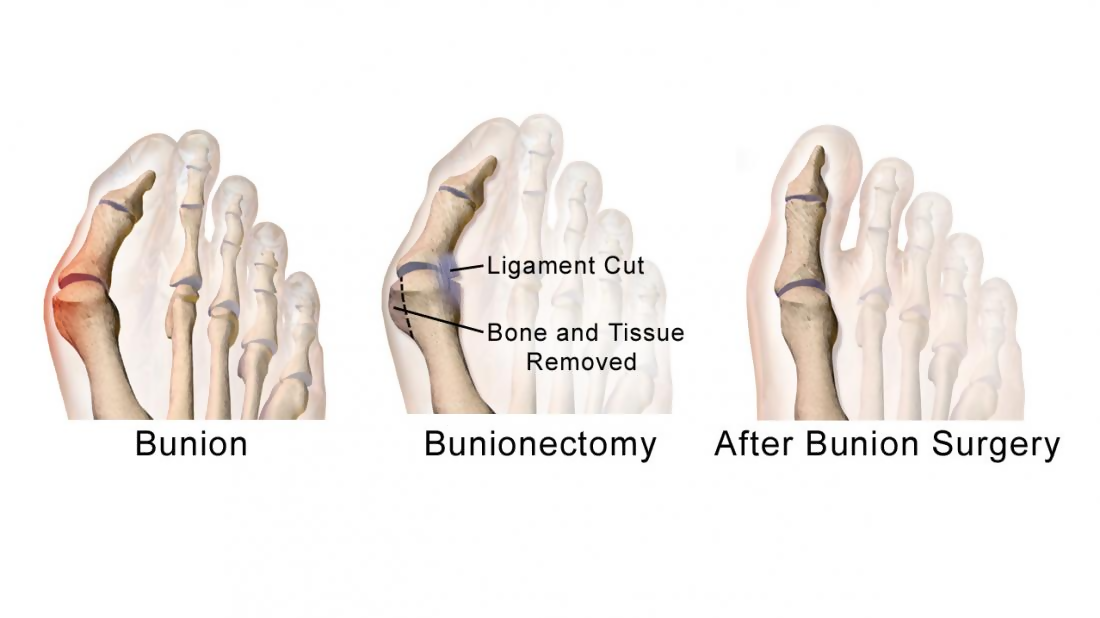
A bunion, usually a bony bump, that forms on the joint of the big toe. It means that some bones at the front of the foot have moved out of place, causing the big toe to pull towards the smaller toes, forcing the joint to stick out. The area around the joint is red and sore. The most obvious symptom of a bunion is a bulging lump at the joint of the toe. Avoid bunion surgery by seeking solutions immediately you notice bunion symptoms.
Causes of bunions
The exact cause of bunions is not known, but other likely reasons are
Foot deformities at birth.
Inherited foot type.
Foot injuries and stresses.
Some bunions have been linked to inflammatory rheumatoid arthritis.
Tight or too-narrow shoes or high-heeled shoes cause bunions though some experts disagree with this.
Other factors that increase the risk of developing bunions are:
Wearing high heels is believed to be the number one risk factor. High heels force the toes to the front of the shoes causing the toes to cramp.
Wearing too narrow or tight shoes, likely pointed, cause bunions due to pressure on the toes cramped together.
The tendency to develop bunions might be a result of inherited anatomy or structure of the foot.
If you have an underlying condition, such as rheumatoid arthritis, it likely favors the development of bunions.
Adolescents, especially girls, are likely to get bunions. It is not known why, but doctors suspect the constant need to change footwear around this age as a contributing factor. However, bunions in adolescents and young people have not been linked to any underlying health condition.
Bunionette forms at the little toe’s joint, often known as a tailor’s bunion, is caused by the pressure put on the side of the foot. It often happens due to sitting cross-legged for long hours, putting pressure on the side of the foot leading to bunions near the pinky toes.
Unless you seek bunion treatment Houston, bunions are permanent. However, several measures will make you comfortable and slow bunion progression. Some measures include
Maintain a healthy weight that does not put pressure on your feet.
Buy the gel-filled pad or moleskin from a drugstore for the protection of the bunion. You need to test the moleskin for a short time to determine if it helps ease pressure and pain.
Buy over-the-counter arch supports or shoe inserts that will position the foot correctly.
Following your podiatrist’s guidance, use a splint at night to ease the discomfort and hold the toe straight.
Take pain killers that are anti-inflammatory such as ibuprofen.
Use massage, warm soaks, and icepacks regularly. If you have circulation problems, consult the foot doctor before using an icepack.
Buy proper fitting shoes with a wide toe box with room for your toes. The heels of the shoes should be lower than two inches.
Immediately you notice changes in the structure of the toe or foot, visit a bunion doctor to avoid complications such as stiff toe, chronic toe pain, and foot/toe deformity.
Over at DeNiel Foot and Ankle Center located in Houston, Texas, and covering surrounding areas like Cypress, and Katy, TX. Ejodamen Shobowale, DPM and her highly skilled staff provide personalized comprehensive care for all your podiatry and sport medicine needs. Whether the issue is foot-related like hammertoes, or toenail fungus or involves pain in the heel , nerves, or joints, Dr. Sho, as she is fondly called, can get you back on your feet in no time.
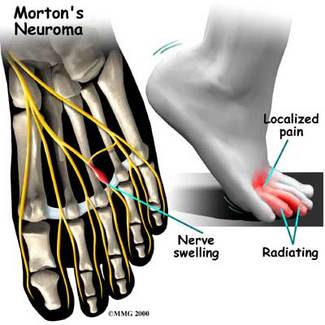
Morton neuroma is the thickening of the tissue around leading to the toes. This is a painful foot condition that affects the ball of your foot, especially in the middle of the third and fourth toes. The pain is sharp and burning and sometimes your toes feel numb. With Mortons feet, you always feel like you are standing on a fold in your sock or as if you are standing on a pebble.
Diagnosis
The neuroma specialist conducts a physical examination by pressing on the foot to determine the tender spot. Further examination is recommended to rule out other issues that could be causing the foot pain. An ultrasound would be the best exam because it uses sound waves to create a real-time image of the internal structures of the body. It will reveal the abnormalities of the neuromas. An x-ray can be done to rule out foot pain causes like a stress fracture. The MRI (Magnetic resonance imaging) uses a strong magnetic field and radio waves to visualize the soft tissues such as the neuromas. This is used when the patient is showing no symptoms of Morton neuromas, but the doctor suspects it could be the issue causing the patient discomfort.
Morton’s neuroma can be uncomfortable and painful to live with. If you think you have Morton’s neuroma and need neuroma treatment, please reach out to the podiatrist at DeNiel Foot and Ankle Center. Their doctor, Dr. Ejodamen Shobowale will take care of all your foot and ankle needs plus answer any questions related to foot issues.
Risk factors contributing to Morton’s neuroma
Foot deformities such as hammertoes, bunions, flat feet, high arches leave the patients susceptible to the development of this condition.
High heels or ill-fitting shoes and too-tight shoes, put extra pressure on the ball of the foot and your toes.
High impact athletic activities such as running or jogging, are subject to repetitive trauma to the feet. Also, sports that feature tight shoes such as rock climbing or skiing put pressure on your shoes.
Overweight people risk getting Morton neuroma because once they wear a high-heeled shoe the extra weight puts extra pressure on the feet.
Managing neuroma foot
There are various ways of managing the foot condition to improve the symptoms
Relieve pressure off the foot by using over the counter shoe pads.
Wear more supportive shoes with a wide toe box. If they have laces avoid tying them too tight. It is recommended that you wear shoes with proper insoles and shock-absorbent soles.
Avoid pointed toed shoes or too tight shoes. Wear shoes whose heels are not more than 2 inches.
Apply ice to the inflamed area to reduce swelling and pain.
Rest your feet as much as possible.
Massage the painful area of the foot.
Wear proper athletic footwear with enough padding to cushion the balls whenever you’re taking part in sports or exercising.
Reduce or manage your body weight so that you improve on the amount of pressure put on your feet.
Neuromatreatment
Medications
Drugs temporally relieve symptoms of Morton’s Neuroma including pain, though, using medications for long is highly discouraged. Some of the medications used include corticosteroid injections and alcohol sclerosing injections. There are anti-inflammatory drugs that are taken orally to reduce inflammation such as aspirin and ibuprofen. You can have an anesthetic injection to temporarily relieve the pain through numbing the affected nerve.
Orthotics
Custom designed shoe inserts that reduce the pain by offloading the pressure off the nerve. The metatarsal pad is placed in the shoe insole for effective working. Custom made shoe inserts are individually designed to fit the different contours of your foot.
Surgery
When medication and management methods do not effectively relieve pain surgery is the next option. The surgical procedure known as neurectomy is used to remove part of the nerve tissue. Before the neurectomy is performed there is a procedure called cryogenic Neuro ablation therapy. In this procedure, cold temperatures are applied to the nerves to destroy the sheath that covers the nerve and the nerve cells. Patients who have undergone this therapy are less likely to experience the symptoms of Morton neuroma again.
Decompression surgery can be done by cutting the structures nearby the nerve to relieve the pressure. Some of the structures removed include ligaments that bind the bones.
A bunion can be painful, and affects the function and movement of the joint. A foot doctor might recommend surgical intervention to offer instant relief. Minimally invasive bunion surgery Houston
is becoming a popular option for treatment that started with the Kramer osteotomy and K-wire.
Why should you consider minimally invasive bunion surgery Houston? Minimally invasive surgery is preferred for mild and moderately painful bunions since
it facilitates easier recovery. For severe bunions, patients undergo open surgery to fix the symptoms of the condition.
The term minimally invasive encompasses a variety of incisional approaches and bunion correction methods. The techniques have been evolving over the past decades.
Best bunion surgeons successfully execute realignment using minimally invasive techniques. Depending on the severity of the bunion, several correction methods are used,
such as realignment osteotomy (bone cutting and bone shaving) or fusion that is bone mending.
Podiatrists use specialized equipment that allows bony correction through small incisional portals made on the skin of the foot.
Minimally invasive bunion surgery Versus bunionectomy
Use of high speed, small cone-shaped bone burs to shave and cut the bony segments, while bunionectomy uses large flat bone saws.
Tiny incisions made during the surgery allow quick recovery while bunionectomy is open surgery that takes significant time to recover.
Experience less after surgery pain that goes away after a short period, allowing you to back to your activities,but after a bunionectomy, you need physical therapy to build strength in your joints.
A short operative and recovery time while for bunionectomy you might not be able to walk for a few weeks.
Minimally invasive procedures offer bunion correction with minimal trauma and disruption of the overlying soft tissue and skin.
Are you the best candidate for minimally invasive bunion surgery?
When conducted by the best bunion surgeon, most bunions can be corrected using minimally invasive techniques. Moderate bunions are easy to correct,
as compared to large and small bunions. Large bunions might require stable fixation and translations, while small bunions pose a challenge orienting the surgical hardware.
A minimally invasive procedure is ideal for active and healthy patients although these surgical procedures are not the best for every bunion patient.
Arthritic patients may require different surgical procedures. Smoking is not a contradiction in bunion surgery; however, it might delay the bone healing process after surgery.
For patients with osteoporosis, the bone quality might require a restrictive postoperative course.
Are there potential complications?
Minimally invasive procedures are not immune to post-surgical complications. Some complications are more amplified, while other complications have fewer effects.
Other bunion surgery complications include infections, recurrence, regional pain syndrome, and joint stiffness.
A minimally invasive realignment with screw fixation has fewer complications and superior outcomes, making it the best bunionectomy procedure.
The techniques and procedures, continue to evolve due to the emergence of new surgical screws and specialized instruments.
Houston bunion surgery today allows tiny incisions, walking recovery, and an easy recovery process.
Over at the DeNiel Foot and Ankle Center in Houston , Texas, covering surrounding areas such as Katy, and Cypress, TX. For all your podiatry
and sports medicine needs, Ejodamen Shobowale, DPM and her highly qualified staff provide personalized comprehensive care.
Dr. Sho, as she is affectionately called, will get you back on your feet in no time, regardless of the patient’s issue.



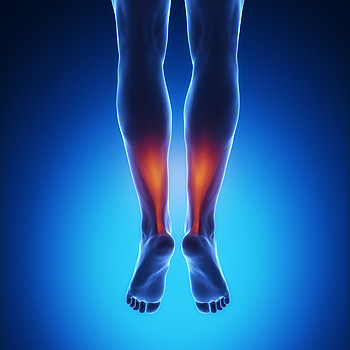
 It is normal for the Achilles ligament to get injured. The tendon stretches from the heel to the calf muscles, and it is the largest tendon in the body. It is springy and is felt at the back of the ankle. It mainly helps raise your toes and point the toes towards the floor. It is common to feel stiffness or burning pain at the back of your leg, which is an indication that the Achilles tendon is partly or entirely torn.