


Cosmetic Foot Surgery in Houston, TX

Cosmetic foot surgery covers procedures chosen to change how the foot looks, as well as how it feels. For most patients the two overlap: a toe that rubs the shoe is also the toe they would rather not show in sandals.
At DeNiel Foot & Ankle Center these procedures are performed by Dr. Ejodamen Shobowale, DPM, a board-certified podiatrist serving Houston, Cypress and Katy.
What counts as cosmetic foot surgery
There is no separate specialty called “cosmetic podiatry.” The procedures are the same ones used to treat pain and deformity — what differs is the reason for having them.
| Procedure | What it addresses |
|---|---|
| Toe shortening | A toe noticeably longer than its neighbours, usually the second |
| Hammertoe correction | A toe that buckles or curls |
| Bunion surgery | The bony prominence at the base of the big toe |
| Toenail restoration | Damaged, thickened or discolored nails |
“Cinderella surgery” — what the term means
You may have seen cosmetic foot procedures described online as “Cinderella surgery” or a “foot makeover.” These are marketing terms rather than medical ones, and they refer to the same operations listed above.
Worth being straightforward about: these are real surgical procedures with real recovery times and real risks. Toe shortening keeps you in a surgical boot for 4–6 weeks, and the final appearance takes up to a year to settle. Anyone presenting foot surgery as a quick cosmetic touch-up is not describing it accurately.
Are you a candidate?
Good candidates generally:
- Are bothered by a specific, identifiable feature — a long toe, a bunion, a curled toe — rather than a general dissatisfaction with how their feet look
- Are in good general health and heal normally
- Can commit to the recovery, including 4–6 weeks in a surgical boot for most toe procedures
- Have realistic expectations about the result
When we would advise against it
Elective surgery is only worth doing when the odds are firmly in your favour. Dr. Shobowale will generally recommend delaying or declining cosmetic correction in these situations:
- Active nicotine use. Nicotine meaningfully raises the risk of non-union — bone that fails to knit — and of wound-healing problems. The usual guidance is to stop 4–6 weeks before surgery and remain off it for 4–6 weeks afterwards.
- Uncontrolled diabetes, poor circulation or neuropathy. Each raises the risk of infection and slow healing, and reduced sensation makes post-operative problems harder to detect early.
- Active infection or broken skin on the foot.
- Expectations surgery cannot meet, or distress that is out of proportion to the finding. If the concern is not something an operation can resolve, an operation is not the answer.
- Being unable to complete the boot recovery — because of work, caring responsibilities or mobility.
- Dancers and competitive athletes warrant particular caution: altering toe length can change how the foot pushes off, which matters more in those activities than in everyday walking.
What it costs
Cosmetic foot surgery is usually paid out of pocket, because insurance covers correction of documented pain, deformity or skin breakdown — not appearance.
- Toe shortening — typically $2,500 to $7,000. Full breakdown →
- Bunion and hammertoe correction — varies with the technique and whether any part is medically necessary
Many patients turn out to have a partly medical case: a toe causing recurring calluses or nail damage is a documented problem, not only an aesthetic one. That determination is made case by case at consultation.
Payment plans are available through Cherry — see financing options.
Recovery, in plain terms
For toe shortening, the most common cosmetic procedure here: you can bear weight immediately, in a surgical boot worn for 4–6 weeks. Most patients are back in regular shoes at 4–6 weeks and back to full activity at around 3 months. Swelling settles over 2–6 months, and the final appearance continues to refine for up to a year.
Recovery after bunion and hammertoe correction differs — see those pages.
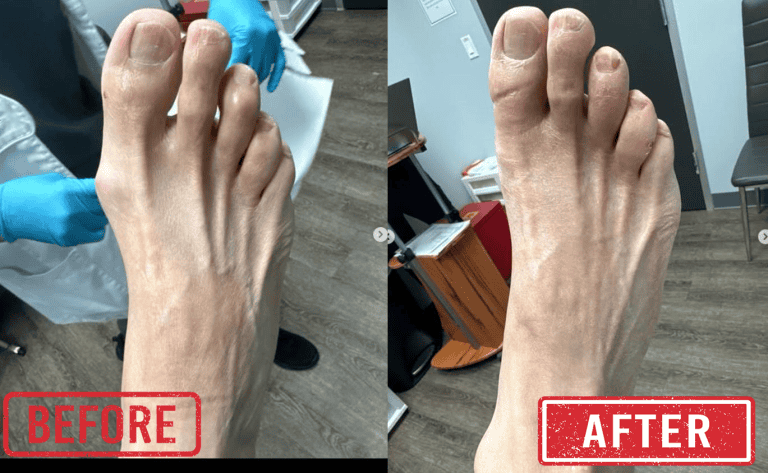
Before and after
Results from patients treated at DeNiel Foot & Ankle Center.


Book a consultation
Dr. Ejodamen Shobowale, DPM · DeNiel Foot & Ankle Center
15003 FM-529 Road, Suite A, Houston, TX 77095
(832) 415-1790
Serving Houston, Cypress, Katy, Jersey Village and Copperfield.
Frequently asked questions
What is cosmetic foot surgery?
Surgery chosen to change the appearance of the foot or toes. The procedures are the same as those used to correct pain and deformity — toe shortening, hammertoe correction, bunion surgery — the difference is the reason for having them.
Is cosmetic foot surgery covered by insurance?
Generally not, when the reason is appearance alone. When a toe or bunion causes documented pain, deformity or skin breakdown, part or all may be covered.
What is “Cinderella surgery”?
A marketing term for cosmetic foot procedures, not a medical one. It refers to the same operations described on this page.
How much does cosmetic toe surgery cost?
Toe shortening typically runs $2,500 to $7,000, depending on how many toes are treated, the technique and the setting.
How long is recovery?
For toe procedures: immediate weight-bearing in a surgical boot for 4–6 weeks, regular shoes at 4–6 weeks, and full activity at around 3 months.
Can I have cosmetic foot surgery if I smoke?
Not while you are still using nicotine. It significantly raises the risk of bone failing to heal and of wound complications. The usual guidance is to stop 4–6 weeks before surgery and stay off it for 4–6 weeks afterwards.