


Morton’s Toe
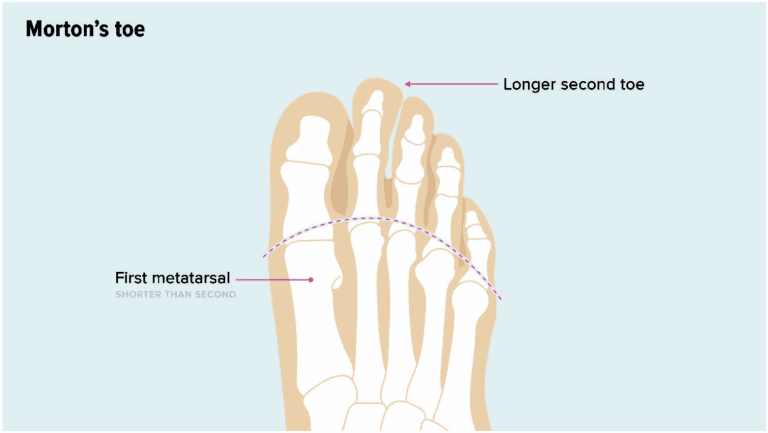
Morton’s toe describes a foot where the second toe extends further than the big toe. It is one of the most common variations in foot shape — not a disease, not a deformity, and for many people not a problem at all.
It takes its name from Dudley Joy Morton, the American orthopaedic surgeon who described the pattern. Despite the shared name, Morton’s toe is not the same as Morton’s neuroma — worth clearing up early, because the two are constantly confused.
What actually causes Morton’s toe
The second toe usually isn’t unusually long. What differs is the bone behind it: in a Morton’s toe, the first metatarsal — the long bone behind the big toe — is shorter relative to the second. That makes the second toe appear longer, and shifts more load onto the ball of the foot behind it during walking.
That load shift is why some people develop symptoms and others never do.
Is Morton’s toe genetic?
Yes — it is commonly inherited, which is why it often runs in families. It is a normal anatomical variation passed down like any other inherited trait, such as foot width or arch height.
Being inherited does not mean it will cause problems. Plenty of people have Morton’s toe their whole lives and never notice.
Morton’s toe vs Morton’s neuroma
Two different things that share a surname.
| Morton’s toe | Morton’s neuroma | |
|---|---|---|
| What it is | A foot shape — second toe longer than the big toe | Thickened tissue around a nerve between the toes |
| Where | The overall proportion of the foot | Usually between the third and fourth toes |
| Symptoms | Often none; sometimes callusing or ball-of-foot pain | Burning, tingling, numbness, a feeling of standing on a pebble |
| Present from | Birth — it’s inherited | Develops over time |
If your symptoms are burning or numbness between the toes rather than pressure under the ball of the foot, you may be looking for Morton’s neuroma treatment instead.
When Morton’s toe causes problems
Most people need no treatment. Symptoms, when they appear, come from the extra pressure carried by the second metatarsal:
- A callus that keeps returning under the ball of the foot, behind the second toe
- Aching or burning under the ball of the foot after standing or walking (metatarsalgia)
- The second toe rubbing the top of the shoe, causing nail damage or skin irritation
- Capsulitis of the second MTP joint — pain and swelling at the base of the second toe itself, often described as the sensation of walking on a marble
- Difficulty finding shoes that fit both the length of the second toe and the width of the foot
Capsulitis is the one worth acting on early. Left untreated it can progress to a tear of the plantar plate — the ligament that stabilises the toe from underneath — and from there to a crossover toe, where the second toe drifts over the big toe. That is the most clinically consequential path from a Morton’s toe, and it is far easier to address before the plate gives way than after. It is also how an untreated Morton’s toe can end up as a hammertoe deformity.
Non-surgical treatment
Almost always the starting point, and usually enough:
- Footwear fitted to the longest toe — not to the big toe — with a toe box deep and wide enough to clear the second toe
- An off-the-shelf metatarsal pad, which shifts pressure off the second metatarsal head
- In-office callus reduction as needed — professional reduction rather than repeated cutting at home, which risks infection
- Custom orthotics if pressure symptoms persist after the simpler measures
A fair trial is 8 to 12 weeks. If pain, callusing or skin breakdown persists after around three months of proper offloading, a surgical conversation becomes reasonable.
When surgery is considered
Surgery is for symptoms, not for appearance alone — though some patients do seek correction for cosmetic reasons, which is a legitimate and separate conversation.
When the complaint is the visible length of the toe, the procedure is materially the same as toe shortening surgery: a small section of bone is removed from one of the bones of the toes, and the toe is stabilised while it heals.
When the complaint is pain under the ball of the foot rather than the toe’s length, the better operation is often a Weil osteotomy — shortening the second metatarsal itself — because it corrects the overload at its source rather than only shortening the toe above it. Lengthening the first metatarsal is also possible, but it is reserved for severe cases and is never performed as a cosmetic procedure.
What treatment costs
Where surgical correction is priced as toe shortening, most patients pay between $2,500 and $7,000, depending on how many toes are treated, the technique used, and the surgical setting. Purely cosmetic correction is generally not covered by insurance; correction for documented pain, deformity or skin breakdown may be. Full cost breakdown →
Recovery
You can bear weight immediately, in a surgical boot worn for 4–6 weeks. Most patients are back in regular shoes at 4–6 weeks and back to full activity at around 3 months. Swelling settles over 2–6 months, and the toe’s final appearance continues to refine for up to a year.
Seeing a podiatrist in Houston
Dr. Ejodamen Shobowale, DPM is a board-certified podiatrist treating foot and ankle conditions across Houston, Cypress, Katy and the surrounding communities from our facility on FM-529. If a long second toe is causing pain, recurring calluses or shoe-fit problems, an examination and X-ray will show whether it is the cause and what is worth doing about it.
DeNiel Foot & Ankle Center
15003 FM-529 Road, Suite A, Houston, TX 77095
(832) 415-1790
Frequently asked questions
What is Morton’s toe?
A foot shape in which the second toe extends further than the big toe, usually because the first metatarsal is shorter relative to the second. It is a common inherited variation, not a disease.
Is Morton’s toe genetic?
Yes — it is commonly inherited and often runs in families.
Is Morton’s toe the same as Morton’s neuroma?
No. Morton’s toe is a foot shape you are born with. Morton’s neuroma is thickened tissue around a nerve, usually between the third and fourth toes, that develops over time and causes burning or numbness.
Does Morton’s toe need to be treated?
Usually not. Most people have no symptoms. Treatment is considered when it causes pain, recurring calluses, capsulitis or shoe-fit problems.
How much does Morton’s toe surgery cost?
Where correction is priced as toe shortening, most patients pay between $2,500 and $7,000 depending on the toes treated, the technique and the setting.
Is Morton’s toe a disability?
No. It is a normal variation in foot anatomy. Any impairment determination is based on your symptoms and how they limit your activity — never on toe length itself. That said, pain that limits what you can do is worth treating regardless of what it is labeled.