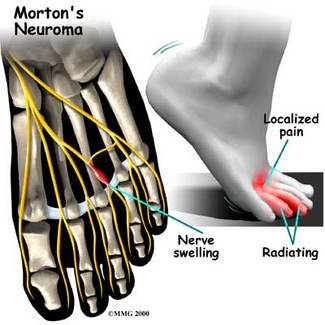
Morton neuroma is the thickening of the tissue around leading to the toes. This is a painful foot condition that affects the ball of your foot, especially in the middle of the third and fourth toes. The pain is sharp and burning and sometimes your toes feel numb. With Mortons feet, you always feel like you are standing on a fold in your sock or as if you are standing on a pebble.
Diagnosis
The neuroma specialist conducts a physical examination by pressing on the foot to determine the tender spot. Further examination is recommended to rule out other issues that could be causing the foot pain. An ultrasound would be the best exam because it uses sound waves to create a real-time image of the internal structures of the body. It will reveal the abnormalities of the neuromas. An x-ray can be done to rule out foot pain causes like a stress fracture. The MRI (Magnetic resonance imaging) uses a strong magnetic field and radio waves to visualize the soft tissues such as the neuromas. This is used when the patient is showing no symptoms of Morton neuromas, but the doctor suspects it could be the issue causing the patient discomfort.
Morton’s neuroma can be uncomfortable and painful to live with. If you think you have Morton’s neuroma and need neuroma treatment, please reach out to the podiatrist at DeNiel Foot and Ankle Center. Their doctor, Dr. Ejodamen Shobowale will take care of all your foot and ankle needs plus answer any questions related to foot issues.
Risk factors contributing to Morton’s neuroma
Foot deformities such as hammertoes, bunions, flat feet, high arches leave the patients susceptible to the development of this condition.
High heels or ill-fitting shoes and too-tight shoes, put extra pressure on the ball of the foot and your toes.
High impact athletic activities such as running or jogging, are subject to repetitive trauma to the feet. Also, sports that feature tight shoes such as rock climbing or skiing put pressure on your shoes.
Overweight people risk getting Morton neuroma because once they wear a high-heeled shoe the extra weight puts extra pressure on the feet.
Managing neuroma foot
There are various ways of managing the foot condition to improve the symptoms
Relieve pressure off the foot by using over the counter shoe pads.
Wear more supportive shoes with a wide toe box. If they have laces avoid tying them too tight. It is recommended that you wear shoes with proper insoles and shock-absorbent soles.
Avoid pointed toed shoes or too tight shoes. Wear shoes whose heels are not more than 2 inches.
Apply ice to the inflamed area to reduce swelling and pain.
Rest your feet as much as possible.
Massage the painful area of the foot.
Wear proper athletic footwear with enough padding to cushion the balls whenever you’re taking part in sports or exercising.
Reduce or manage your body weight so that you improve on the amount of pressure put on your feet.
Neuromatreatment
Medications
Drugs temporally relieve symptoms of Morton’s Neuroma including pain, though, using medications for long is highly discouraged. Some of the medications used include corticosteroid injections and alcohol sclerosing injections. There are anti-inflammatory drugs that are taken orally to reduce inflammation such as aspirin and ibuprofen. You can have an anesthetic injection to temporarily relieve the pain through numbing the affected nerve.
Orthotics
Custom designed shoe inserts that reduce the pain by offloading the pressure off the nerve. The metatarsal pad is placed in the shoe insole for effective working. Custom made shoe inserts are individually designed to fit the different contours of your foot.
Surgery
When medication and management methods do not effectively relieve pain surgery is the next option. The surgical procedure known as neurectomy is used to remove part of the nerve tissue. Before the neurectomy is performed there is a procedure called cryogenic Neuro ablation therapy. In this procedure, cold temperatures are applied to the nerves to destroy the sheath that covers the nerve and the nerve cells. Patients who have undergone this therapy are less likely to experience the symptoms of Morton neuroma again.
Decompression surgery can be done by cutting the structures nearby the nerve to relieve the pressure. Some of the structures removed include ligaments that bind the bones.
Morton’s neuroma causes thickening of the tissue around the nerves leading to your toes. It is a painful condition affecting the ball of your foot between the third and fourth toes and the tissue around the nerves. Neuroma foot feels like you are standing on a pebble or a fold in your sock. It causes a burning, sharp pain in the ball of the foot that radiates into the toes. The toes may feel numb, sting, tingling, and a burning sensation.
Who is vulnerable to developing Morton’s Neuroma?
Certain footwear
Shoes that are ill-fitting or high heeled shoes place extra pressure on the toes, and the ball of the foot causes the development of Morton’s Neuroma. It commonly affects women who wear high heels more because of compressing the toes together.
Certain sporting activities
High impact athletic activities that cause repetitive trauma to the feet, such as running and jogging, put extra pressure on the nerve of the foot. Also, sports that require wearing tight shoes such as rock climbing and snow skiing that puts pressure on your toes.
Foot deformities
Experts believe foot deformities are be associated with Morton’s Neuroma development. It is because the conditions cause the metatarsal bones to rub against the nerves. If you have the following, you might be vulnerable to the development of neuroma foot:
Hammertoes, where the middle joint of the toe is bent, and pressure is applied when one has footwear on.
A bony swelling, known as a bunion, puts pressure on the nerves of the foot.
Irregularly positioned toes.
Flat feet if you have a low arch or have no arch at all.
High arches that cause the instep of the foot to be raised.
Overweight
If you are overweight, you are at risk because the extra weight puts pressure on your feet. If you add footwear, it causes pressure to build on the nerves in the foot.
Home remedies
If you are experiencing pain from Morton’s neuroma, consider self-care to allow the nerve to heal.
Take over the counter anti-inflammatory medications to relieve pain and reduce swelling.
Use ice packs regularly massage to reduce pain. Roll the pack over the affected area and painful site.
If you are suffering due to foot deformities, you can buy footpads and arch supports. Fit inside your shoe to reduce the pressure placed on the nerve. They are available over the counter or consult a foot doctor who can mold an exact fit for your foot.
Change your footwear to lower heeled shoes or shoes with extra depth and a broad toe box.
Take a break from active sports. You can reduce aerobic exercises, jogging, or dancing that put extra pressure on your feet.
If these home remedies do not work, the doctor might recommend other Morton’s neuroma treatment such as steroid injection, decompression surgery, and in severe cases, removal of the nerve is done.
Here at DeNiel Foot and Ankle Center located in Houston, Texas, and covering surrounding areas like Cypress, and Katy, TX. Ejodamen Shobowale, DPM and her highly skilled staff provide personalized comprehensive care for all your podiatry and sport medicine needs. Whether the issue is foot-related like hammertoes, or toenail fungus or involves pain in the heel , nerves, or joints, Dr. Sho, as she is fondly called, can get you back on your feet in no time.